Web Design for Academics & Researchers

Your work deserves
more than a faculty page.

Your university profile is a name, a title, and a phone number in a directory that looks like everyone else's. We build custom personal sites for academics and researchers — a real home for your publications, your projects, your teaching, and your voice — so that when journalists, funders, students, and collaborators come looking for you, they find the best version of your work.

Academic Sites We've Built

One signed faculty client and three concepts across the sciences and humanities — each one built around a different scholar, a different audience, and a different field. No template anywhere on the page.
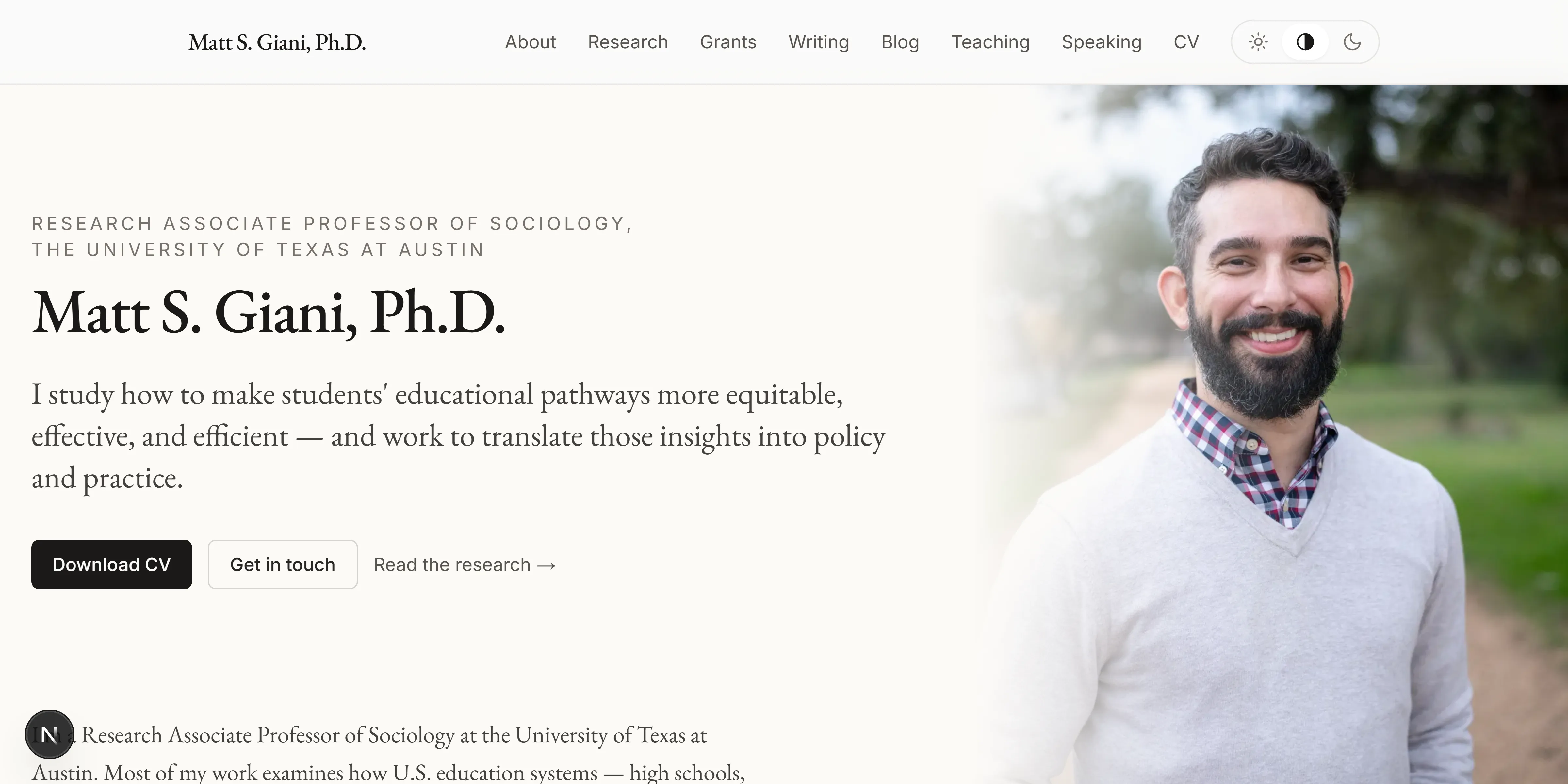
Dr. Matt S. Giani sociology faculty website
View Site →

Academics  ·  Client Project

Matt S. Giani, Ph.D. — Sociology

A research home base for a UT Austin sociologist studying educational equity — publications, reports, op-eds, a downloadable CV, and an interactive Texas education data map, with a built-in editor he updates himself.
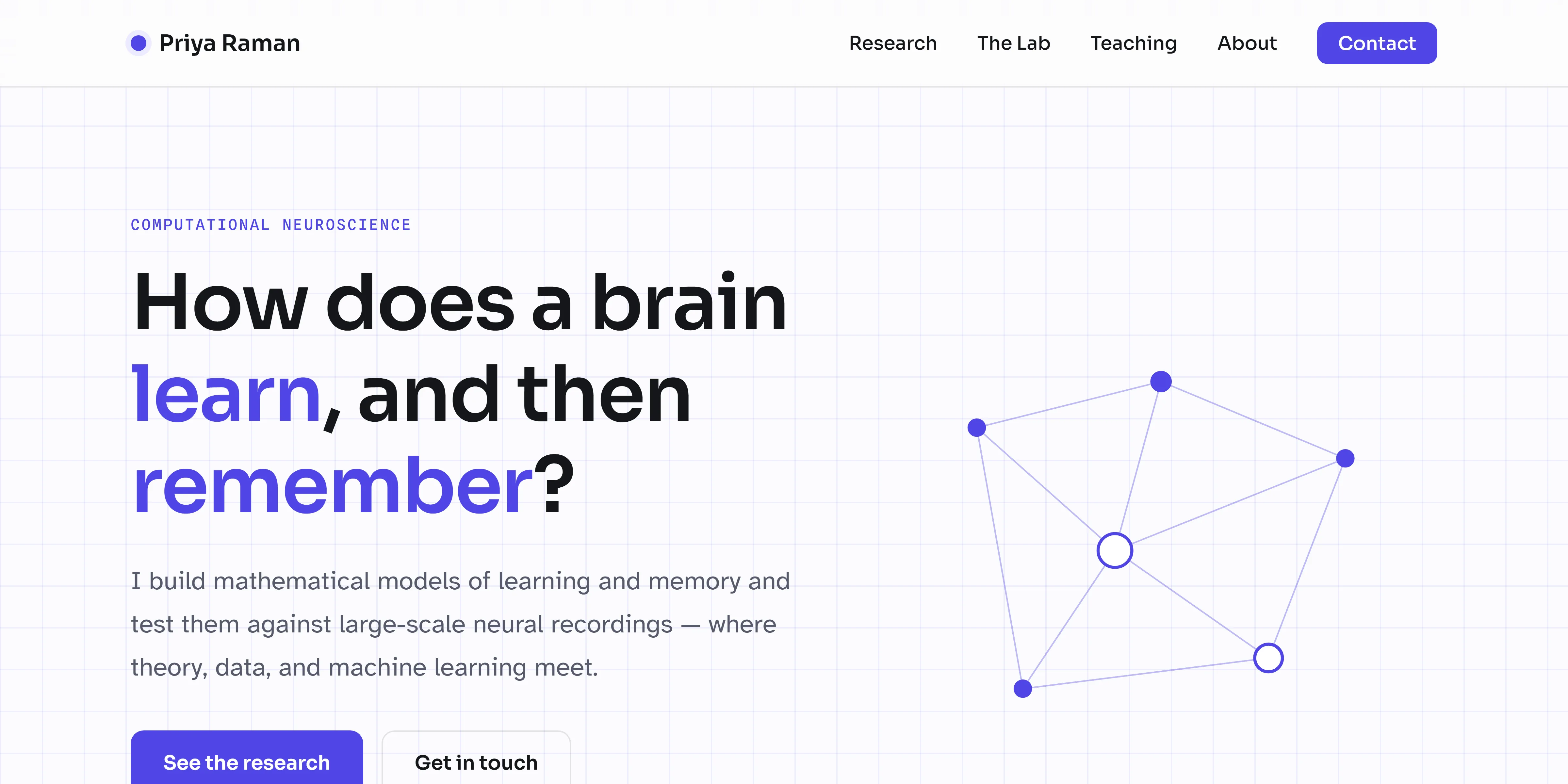
Dr. Priya Raman computational neuroscience faculty website
View Site →

Academics  ·  Concept Project

Priya Raman — Computational Neuroscience

A credibility-first faculty site for a computational neuroscientist. An indigo system and a neural node-network motif frame clear sections for publications, the lab, and teaching.
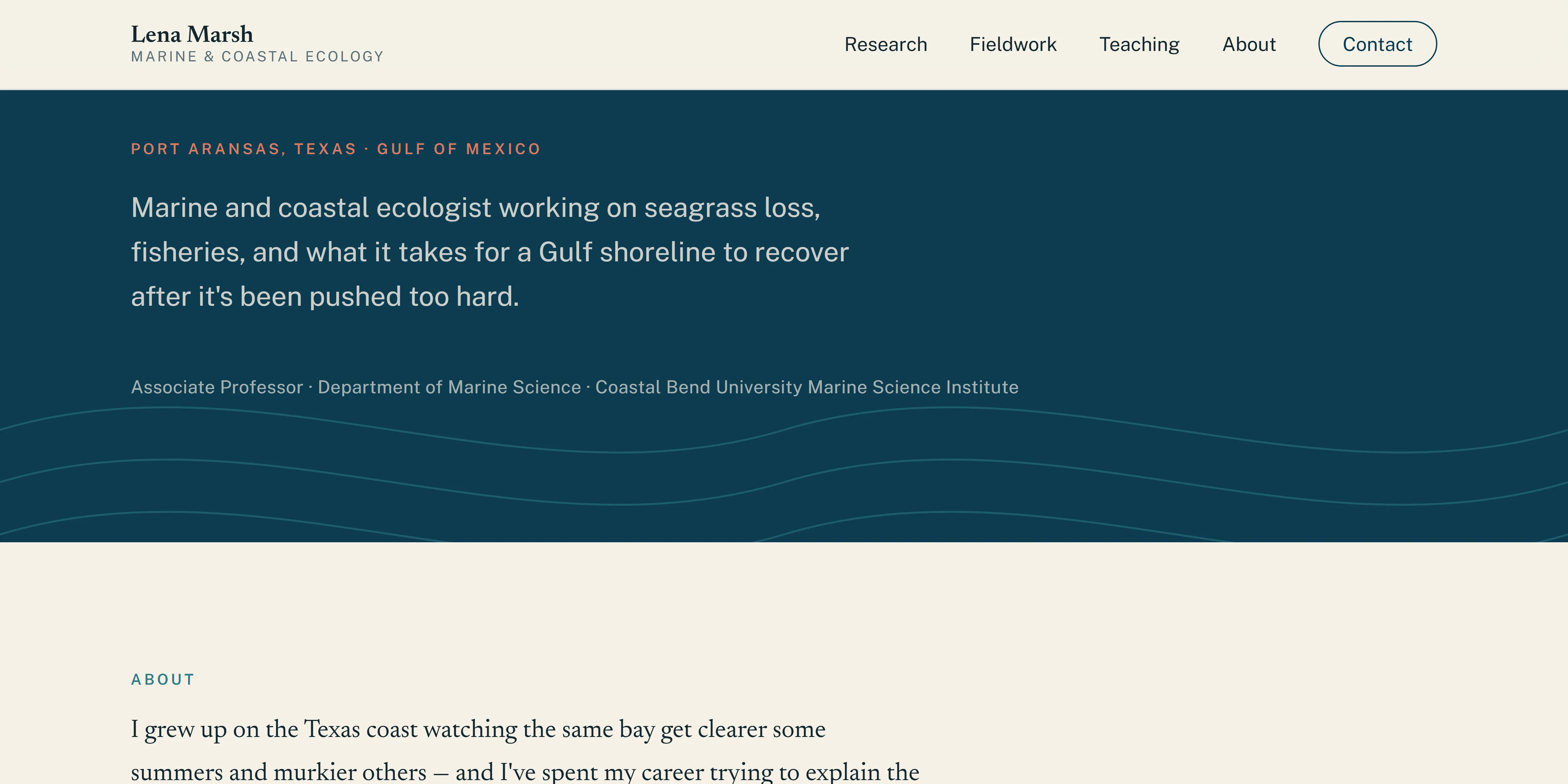
Dr. Lena Marsh marine and coastal ecology faculty website
View Site →

Academics  ·  Concept Project

Lena Marsh — Marine & Coastal Ecology

A coastal-science site for a marine ecologist studying seagrass and Gulf fisheries. A deep-ocean hero, a selected-publications list, and a featured fieldwork project.

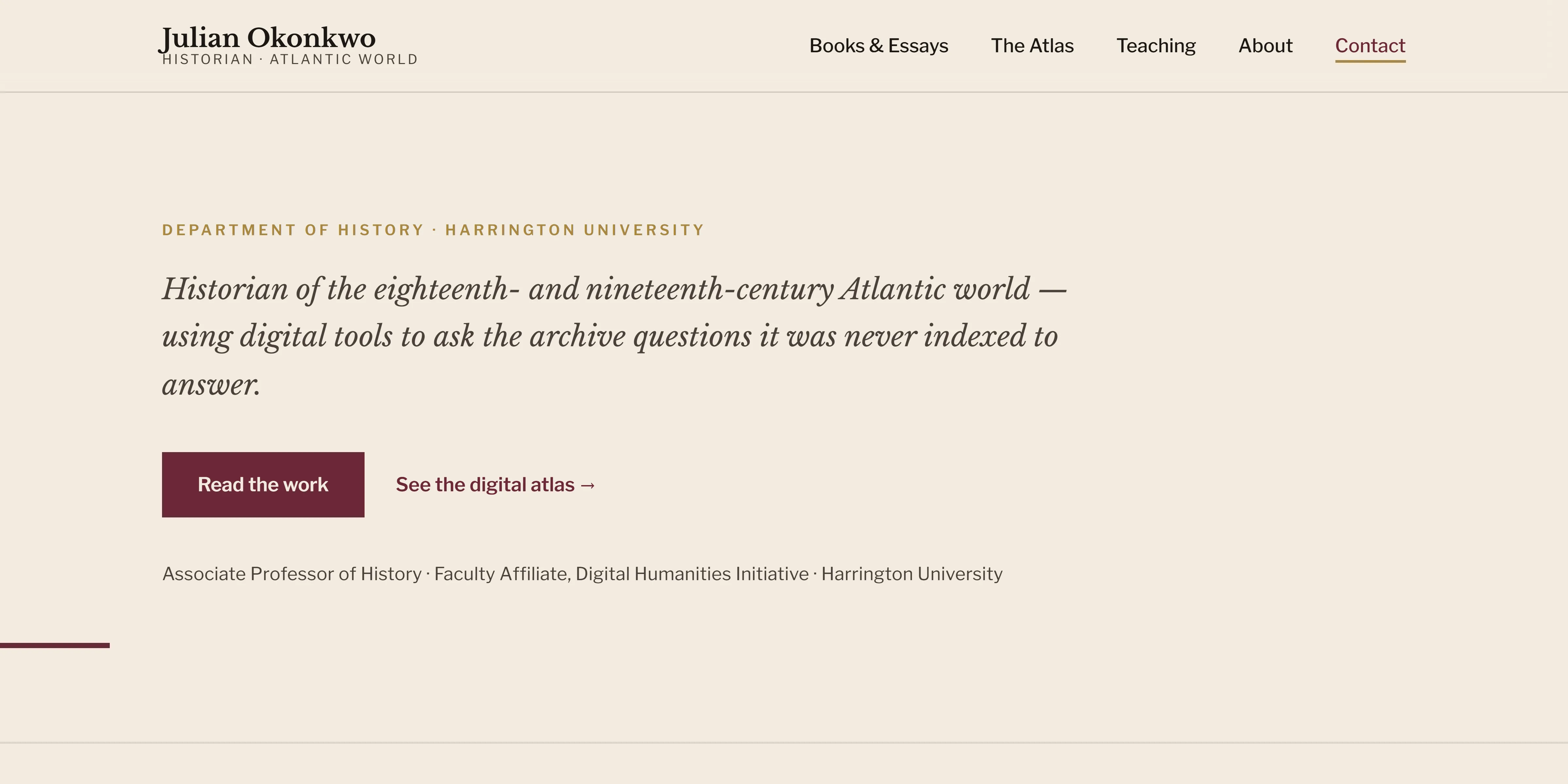
Dr. Julian Okonkwo Atlantic world historian faculty website
View Site →

Academics  ·  Concept Project

Julian Okonkwo — Atlantic World History

An editorial site for a historian of the Atlantic world. Warm archival paper tones, a drop-cap bio, a books-and-essays list, and a featured digital-mapping project.

See the full portfolio →

Your Work, Your Home Base

Where a site of your own fits in.

Your university gives you a lot — an institutional email, library access, a line in the department directory. A site of your own isn't a replacement for any of that. It's the home base every other part of your professional life can point back to. Here's what it adds:

  • One link for everything. Your email signature, conference bios, grant applications, journal author pages, and social profiles can all point to a single place that you control and that always shows your best work.
  • Found when your name is searched. Journalists on deadline, prospective students, and program officers Google you. A site of your own puts your real work at the top — instead of a stale directory page or someone else with your name.
  • Your research, explained for humans. Translate your work for the audiences who fund it, cover it, and study under you — not only the handful of specialists who read the journal.
  • Yours when you move. A new institution, a sabbatical, an emeritus chapter — your .edu page disappears when you leave. A site of your own follows you for your whole career.

What We Build

Built for how your work actually gets found.

Every academic site we build includes the six things that turn a name search into a citation, an invitation, or a new student.

Your scholarly brand

Your face, your bio, your voice — built to position you as the authority in your field, not a row in a directory.

Publications & CV

A clean, current list of papers, books, and a downloadable CV — linked to DOIs, preprints, Google Scholar, and ORCID.

A press & media kit

Headshots, a short bio, your areas of expertise, recent commentary, and a clear contact path — so journalists can cover you fast.

Teaching & students

Courses, mentoring, and a clear "how to work with me" path for prospective grad students and collaborators.

Mobile-first, fast

Loads instantly on every screen, reads beautifully on a phone, and meets accessibility standards out of the box.

Found in a name search

Schema markup, clean titles, and the on-page foundations that put you at the top when someone searches your name or your field.

The Name-Search Edge

When someone Googles you, what comes up?

The big academic databases — Google Scholar, ResearchGate, your university directory — own the generic listings. You won't beat them on "sociology research," and you don't need to.

What you can own are the searches with real intent — the ones a reporter, a prospective PhD, or a program officer actually types when they're looking for you:

Matt Giani UT Austin sociology education equity researcher Texas computational neuroscience lab seagrass ecologist Gulf of Mexico Atlantic world historian

We build your site so that when someone types your name, the first thing they find is the home you control — current, polished, and pointing every visitor back to one place: your work.

FAQ

Common questions from academics.

Yes — keep it. Your department profile and your own site do different jobs. The .edu page is a directory listing the university controls; your site is the polished home base you control, that you can shape however you like, and that follows you if you ever change institutions. Most academics simply link the two together.
Typically 3 to 4 weeks from kickoff to launch. Faster if your CV, publication list, and headshot are ready; longer if we're helping organize your research into sections or writing plain-language summaries together.
Yes. For everyday updates — a new publication, a talk, an op-ed, a blog post — we can build a simple editor so you can post without us. Larger redesigns or new sections, we handle. (Matt Giani's site, for example, has a built-in content editor he runs himself.)
We can link out to your Google Scholar, ORCID, and journal author pages, and keep a clean curated list on the site with DOIs and preprint links. Full automatic syncing from a database is possible, but a hand-curated list almost always reads better — and lets you feature the work you most want seen.
Yes. Contact forms can be wired straight to your inbox, and we can set up a professional email address on your own domain (name@yoursite.com) so press and collaborators reach you at a stable address that isn't tied to one institution.

Wondering if Wix or Squarespace would work instead? Read our honest comparison →

Ready to give your work a home?

Book a 30-minute call. We'll talk through your work, your audiences, and whether a site of your own is the right move for you.

Let's Talk →